Advance payment invoice: deadline and contents
An advance payment invoice documents money that arrived before delivery. Here is the deadline, the required contents, the final-invoice rule and the KSeF markers.
An advance payment invoice is the invoice issued after receiving all or part of the payment before the goods are delivered or the service is performed. It documents the payment itself, not a sale that has yet to happen.
In Polish law it is the invoice from art. 106b(1)(4) of the VAT Act. The name "advance invoice" is practical shorthand; in KSeF the document already has a formal marker.
What follows is the full cycle: the deadline, the contents, the relationship to the final invoice, several payments on one order, corrections and refunds, and the KSeF markers.
What an advance payment invoice is
The trigger is money that arrived before the delivery. The act names prepayments, advances, deposits and instalments, so what you call the payment does not change the document.
Under art. 19a(8) of the VAT Act the tax point arises when such a payment is received, in respect of the amount received.
An advance invoice is therefore neither an offer nor a payment request. It is an accounting document describing an event that has already occurred.

Advance, deposit and prepayment are one document
The difference between an advance and a deposit is a civil-law one, and it matters when a party withdraws from the contract. The way the payment is invoiced stays the same.
It is still worth naming the payment in the order or the contract. In a dispute about a refund that wording decides, not the invoice type.
Which sales the provision points to
Art. 106b(1)(4) refers back to two points of the same paragraph: sales to another taxable person or to a legal person, and intra-Community distance sales of goods.
The same point excludes intra-Community supplies of goods and the transactions in art. 19a(5)(4) and 19a(1b). The full list of exclusions is published by biznes.gov.pl.
Whether your particular sale falls inside that scope is a question for your accountant. This text describes the procedure and the contents of the document.
When to issue an advance payment invoice
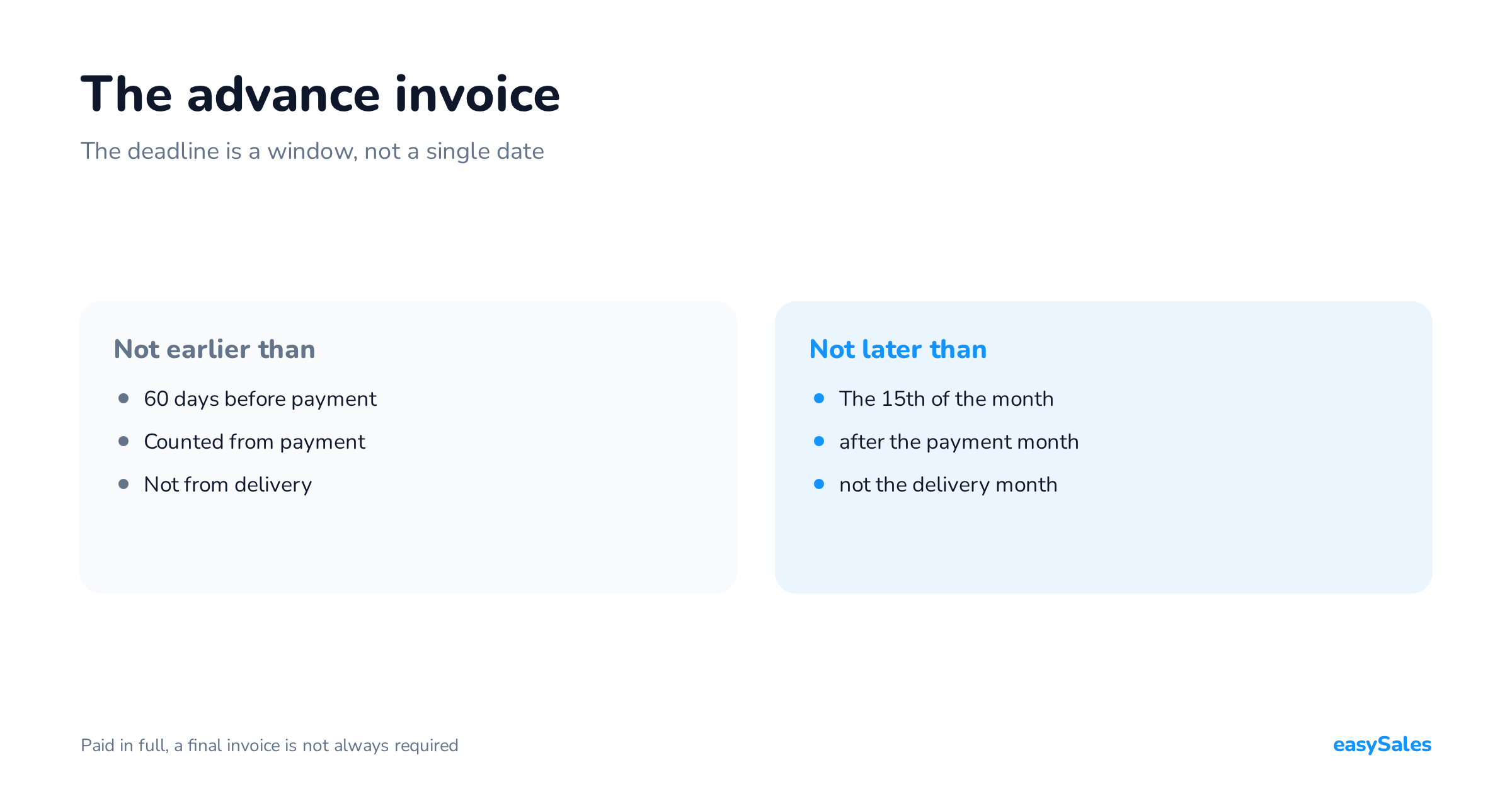
The deadline has two edges, and they are counted from different events. The outer one runs from the month of the payment, the inner one from the payment itself.

No later than the 15th of the following month
Art. 106i(2) sets the 15th day of the month following the month in which all or part of the payment was received from the buyer.
What counts is the month of the payment, not the month of the delivery. A transfer received on 30 September is due by 15 October, even if the goods ship in November.
No earlier than 60 days before the payment
Art. 106i(7)(2) forbids issuing an invoice earlier than the 60th day before receiving all or part of the payment. A document issued before that breaks the deadline.
This is the most common stumble on long-horizon pre-orders. Instead of an early invoice, issue a proforma, and the advance invoice once the payment is booked.
When a separate advance invoice may be skipped
Art. 106b(1a) removes the requirement to issue the invoice from paragraph 1(4) where all or part of the payment arrived in the same month as the transaction.
The details of the payment received then go on the invoice issued after delivery, as art. 106e(1a) provides. The exception does not apply to the cases in art. 106i(3)-(8).
What an advance payment invoice must contain
The list is shorter than on a basic invoice, but it holds two items that are not there at all: the amount received and the order data.

Order data instead of invoice lines
Art. 106f(1)(4) requires the data of the order or the contract: the name of the goods or service, the quantity ordered, the value excluding tax, the rates, the tax amounts and the order value including tax.
In the FA(3) structure this is the Zamowienie node. The Ministry states in its published Q&A that this node applies only to advance invoices and their corrections, and that the FaWiersz node is not filled in on such an invoice.
The tax amount comes from a formula
The tax is not computed on the order value but on the amount received. Art. 106f(1)(3) gives the formula: the payment received times the rate, divided by 100 plus the rate.
The payment is therefore treated as a gross amount. On a payment of PLN 1,230 at a 23% rate the tax is PLN 230.
Advance payment invoice versus final invoice
These are two separate documents with inverted contents. The advance one shows the order and the payment; the final one shows the real delivery and the balance left.

How the values are reduced
Art. 106f(3) is explicit: where the advance invoice does not cover the whole payment, the invoice issued after the goods are handed over reduces the total value by the payments already received.
The tax amount is reduced by the sum of the tax shown on the advance invoices. Only the difference is left on the final invoice.
Advance-invoice numbers on the final invoice
The same paragraph requires the final invoice to carry the numbers identifying the advance invoices in KSeF. For invoices issued outside the system, their own numbers are given.
The FakturaZaliczkowa node holds them, and it may appear up to one hundred times on one invoice. What the KSeF number actually is we unpack separately.
An advance payment invoice for 100% of the value
The most common question on this topic is whether a final invoice is still needed once the whole amount has been paid.

The Ministry answers in the KSeF 2.0 handbook: where 100% of the payment is documented by an advance invoice, there is no requirement to issue a settlement invoice.
The rules do not forbid one, though. Such a final invoice is an additional record of the sale and shows that the amount due was settled in full.
On a "zeroed" settlement invoice the total due in field P_15 is 0, the FaWiersz node carries the full transaction values, and the advance invoice's number goes into the FakturaZaliczkowa node.
Advance payment invoice versus proforma
The boundary is sharp and it runs through the moment of payment. A proforma comes before the money; an advance invoice documents it.
Biznes.gov.pl describes a proforma as a document that is not an accounting record and serves an informational purpose only. The term itself does not appear in the legislation.
The same service adds the rule that is easiest to trip over: a proforma is not issued after the payment has been received. An advance received is documented by an invoice.
The consequence in KSeF is simple. A proforma is not an invoice within the meaning of the VAT Act, so it never enters the system.
A proforma does not stand in for an invoice once an advance has arrived. If the payment is in, the deadline in art. 106i(2) runs regardless of the fact that the buyer received a proforma.
Several advances on one order
Orders split into several payments are routine in trade. The rules do not cap how many there may be, but they impose one ordering principle.

The last advance invoice closes the chain
Art. 106f(4) covers the case where more than one advance invoice was issued and together they cover the whole payment.
The last of them also carries the numbers of the earlier ones: in KSeF the numbers identifying those invoices in the system, outside KSeF the numbers assigned by the issuer.
One invoice for several payments
The FA(3) structure allows several payments to be documented on a single advance invoice. The ZaliczkaCzesciowa node does that, and it may appear at most 31 times.
Each occurrence carries its own date of receipt and its own amount. Field P_15 then holds the sum of those amounts.
Correcting an advance invoice and refunding a payment
Advances come back more often than the guides suggest. Orders dissolve, buyers change their minds, goods fail to arrive.
Art. 106j(1)(4) names the refund of all or part of the payment as its own ground for issuing a correcting invoice.

There is no cancelling in KSeF
Once the KSeF number has been assigned, the invoice has entered legal circulation. The Ministry states plainly that cancelling an issued invoice is not possible in the system.
Every error is fixed with a correcting invoice. We covered the mechanics of corrections in more depth in the piece on corrections in KSeF.
A correction is entered as a difference
The summary amounts on a correcting invoice are entered as the difference against the original invoice, not as the new target amount.
For a corrected advance the Ministry additionally recommends showing the before and after state in the Zamowienie node, even when the order value does not change.
Advances in KSeF: the ZAL, ROZ and KOR_ZAL markers
In KSeF the type of a document does not follow from a heading typed by hand. It follows from the RodzajFaktury field in the FA(3) structure.
Four markers that concern advances
ZAL— the invoice documenting receipt of all or part of the payment before the transaction.ROZ— the invoice settling an advance invoice, that is, the final one.KOR_ZAL— a correcting invoice to an advance invoice.KOR_ROZ— a correcting invoice to a settlement invoice.
The structured invoice itself, its template and the remaining types are the subject of our guide to the structured invoice.
The KSeF number replaces your own numbering in references
Wherever the rules require the numbers of earlier invoices, e-invoices are referenced by their KSeF numbers. Your own numbering is left for documents issued outside the system.
Sample XML files for each of these cases are published by the Ministry on the National Revenue Administration site, in the example set for the FA(3) structure.
Advances in online selling: pre-orders, B2B and made-to-order goods
In retail the payment and the shipment usually fall inside one month. Advances come into play in a few specific set-ups.
Three set-ups where the payment runs ahead of the delivery
- Pre-orders. The buyer pays now and the release is weeks away.
- Made-to-order goods. Furniture, print, personalisation — the payment starts production.
- Large B2B orders. Split into an initial payment and a balance before dispatch.
In each of these the risk of missing the deadline in art. 106i(2) grows, because the payment and the delivery drift into two different months.
The data an advance invoice needs is created earlier, in the order: lines, quantities, rates and the value of the whole order. That is what fills the Zamowienie node.
If orders from the shop and the marketplaces land in one system, that data set is complete before the payment arrives. We connect it to invoicing in the KSeF module, and we described automatic invoices for Allegro orders separately.
Checklist: what to verify before issuing an advance invoice
The order below is resistant to the most common stumbles, because each item closes the condition for the next one.
Seven checks before the document goes out
- Check the date the payment was booked — the deadline runs from it, not from the order date.
- Confirm the payment has actually arrived. Before it, the right document is a proforma.
- Compute the tax on the amount received using the formula in art. 106f(1)(3).
- Fill in the order data and omit the invoice lines.
- If this payment closes the total, add the numbers of the earlier advance invoices.
- After delivery decide whether a settlement invoice is needed, and reduce the values by the advances.
- When refunding a payment, issue a correction instead of looking for a cancel option.
The scope of the obligation, the exceptions for particular transactions and the VAT consequences are for your accountant. This text describes the procedure and the contents of the document, not your tax position.