Proforma invoice: what it contains and why KSeF skips it
A proforma invoice announces a transaction but is not an invoice under Polish VAT law. What it contains, when to issue it, and why it stays outside KSeF.
What a proforma invoice actually is
A proforma invoice is a commercial document that announces a transaction. It shows the buyer what they are buying, at what price and how much to pay — but it is not an invoice under Polish VAT law.
The government portal biznes.gov.pl puts it in one sentence: a proforma is not an accounting document and serves an informational purpose only.
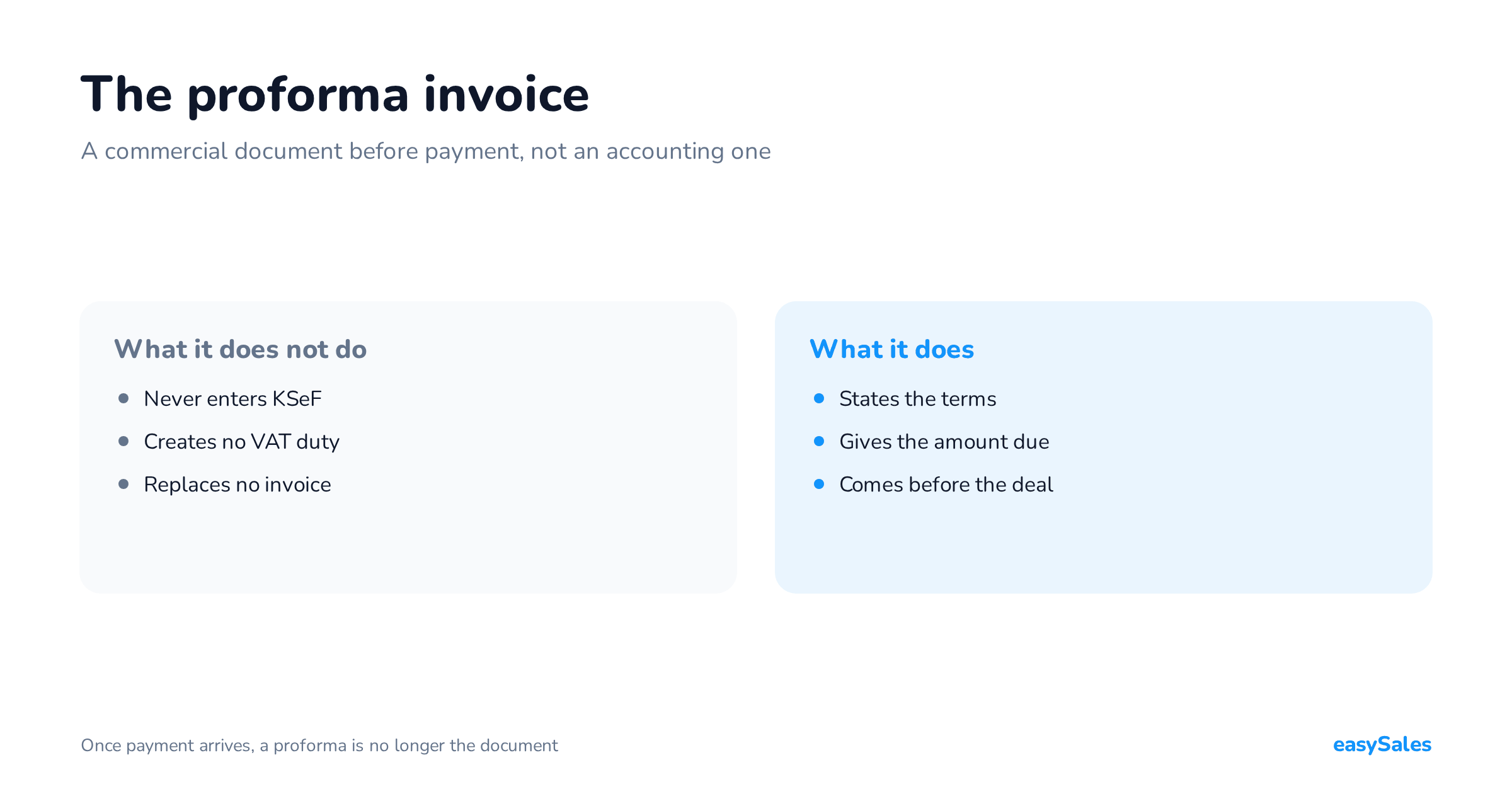
Almost everything below follows from that one sentence. It is not entered in the books, it reflects no sale, and it does not go to KSeF.
The four roles a proforma plays
The same document can be a commercial offer, a statement of the amount due, a payment request or a notice of the advance required. All four roles sit before payment.

That is why a proforma is useful at exactly one moment: when the deal is agreed but the money has not arrived yet.
"Proforma" or "pro forma" — how to spell it
Polish dictionaries give the two-word spelling. PWN's orthographic dictionary lists the entry pro forma together with the example „faktura pro forma”.
In practice both spellings circulate side by side. The same gov.pl page writes „faktura pro forma” in one place and „faktura proforma” in another — and neither is a statutory term.
How a proforma differs from a real invoice
The difference is not in the layout. A proforma can carry exactly the same line items and totals as an invoice and still produce no effect whatsoever in the books.

The row that matters most is the accounting one. An invoice is the basis for the entry; a proforma is not entered in the accounting records, because it reflects no completed sale.
An invoice issued in KSeF has one further trait: it is a structured XML file rather than a PDF. We cover it in a separate piece on the structured invoice.
What a proforma invoice should contain
There is no statutory template. Since the VAT act does not recognise the document, there is also no list of elements whose absence would be a formal defect.
What remains is practice, and practice is simple. A proforma repeats the data that will shortly appear on the invoice and adds what an invoice usually lacks: payment terms and a due date.

The one requirement: a visible "pro forma" label
The only guidance gov.pl gives concerns how the document is marked. A proforma should carry the words „pro forma”, so that nobody mistakes it for an invoice.
The label works on both sides of the deal. Your accounting knows not to post it, and the buyer's accounting knows an invoice is still to come.
Numbering kept out of the invoice series
Number proformas in a series of their own. An invoice has to carry a sequential number within one or more series that uniquely identifies it, so proformas are kept out of that numbering.
A pattern that does not go wrong: PF/2026/09/001 for proformas and a separate, unbroken series for invoices. With two series nobody has to guess which document has tax consequences.
Can a proforma be corrected or cancelled
A proforma has no correction document. A correction note applies to an invoice, and a proforma is not one — if the price or the quantity changes, you issue a new proforma and tell the buyer the previous one is void.
Cancelling works the same way. Withdrawing an offer needs no correcting document — a clear note against the new number is enough for the buyer's accounting to know which document is current.
Does a proforma invoice oblige anyone to pay
The document itself does not settle that. A proforma is not an invoice and reflects no completed sale, so it is not the thing that decides whether and when the buyer pays.
Payment follows from what the parties agreed: the order, the shop terms, the conditions of the offer. A proforma states the amount and the method; it does not create the obligation.
When a proforma works as a payment request
Gov.pl lists a payment request as one of the roles a proforma plays. In practice it plays that role once an order exists and the parties have agreed on prepayment.
To be readable for the buyer it needs a due date and a stated consequence of missing it — for instance, that the offer expires after that date.
Is a proforma binding on the seller
A proforma is an offer, and offers have an expiry. The "valid until" field is not decoration: without it, explaining why a price quoted two months ago no longer holds is an argument you will lose.
Proforma invoice versus the final invoice
A proforma does not turn into an invoice. They are two separate documents: the first announces the transaction, the second documents it, and payment stands between them.

Issuing a proforma does not remove the obligation to issue an invoice once goods are delivered, a service is performed or an advance is received. The closing document of the transaction is an invoice, not a proforma.
The trap: a proforma issued after payment
A proforma is not issued after payment has been received. Receipt of payment, including an advance, is documented with an invoice — this is stated by biznes.gov.pl.
In online selling this trap has a very specific shape. The buyer pays in the basket and only then asks for "a proforma for our accounting".
By that point the correct document is already an invoice, and the request for a proforma is in substance a request for an invoice.
An advance invoice is a different document
The line is sharp. A proforma announces an advance and has no accounting effect, whereas an advance invoice documents an advance that has already arrived and is a genuine invoice.
So the sequence is often three-stage: proforma, advance transfer, advance invoice. We cover how such an advance is settled in the piece on the advance payment invoice.
Proforma invoices and KSeF
A proforma does not go to KSeF. The Ministry of Finance answers this directly: under the VAT act a proforma is not an invoice, so issuing such documents does not happen in KSeF.
That answer sits on the official KSeF 2.0 questions and answers list. The same list adds that the system covers invoices, not orders or acceptance protocols.

A proforma is no exception here. Bills, debit and credit notes, internal invoices, internal vouchers and unstructured attachments all stay outside the system too.
What changes in your document flow
On the proforma side, nothing changes. You issue it as before, in your own software, as a PDF, and send it to the buyer.
What changes is the document that follows it. An invoice issued in KSeF receives a number assigned by the system and a separate receipt confirmation — we cover that in the piece on the KSeF number and UPO.
How to get the proforma to the buyer
Since the system does not carry it, you pick the channel. An email with a PDF attached, a download link in a customer panel or a printout — each is valid.
One thing is worth setting up from the start: make sure the proforma and the invoice from the same transaction can be tied together by order number. Without it, reconciling payments stays manual work.
When a proforma is worth issuing in online selling
A proforma makes sense where payment precedes dispatch and the buyer needs a document to release that payment. In a marketplace basket, no such moment exists.

Orders paid by bank transfer
With prepayment a proforma replaces three emails. The buyer gets the amount, the account number, the payment reference and the due date in one file they can pass on internally.
Proformas for a buyer abroad
Selling outside Poland gives a proforma one extra job: the buyer's bank often needs a document before the transfer will leave at all. State the currency, an account in that currency and the buyer's VAT number.
Exchange rates and the settlement method belong to the invoice, not to the proforma. That is a question for an accountant, not for a document that merely announces the transaction.
Where a proforma has no place
Orders paid in the basket are already paid, and after payment the correct document is an invoice. That single rule removes most arguments about who should be sent what.
Proformas in an order management system
If you issue proformas regularly, one thing matters: that they are built from order data rather than retyped. The line items, the totals and the buyer's details are already in the system.
In easySales the document is generated from the order through a connected billing account, and whether it comes out as a proforma or an invoice follows from that account's settings. Two accounts therefore serve two flows.
The invoice from the same transaction is then sent to KSeF from the same place, with no file export. What that looks like in the settings is described on the KSeF invoicing page.
Before you issue the next proforma
Five things to check on a proforma
- A visible „pro forma” label in the document header.
- A number from its own series, not from the invoice series.
- The date until which the quoted price holds.
- The account number and payment reference, ready to copy.
- The order number that will tie the proforma to the later invoice.
This piece describes what gov.pl and the Ministry of Finance publish about proformas. The scope of obligations in your own company, and the tax treatment of a particular transaction, is for your accountant — send questions about your own situation there.