GPSR: what data every online offer has to carry
The GPSR is the EU general product safety regulation. See who it applies to and what data every online offer has to carry.
The GPSR is the EU general product safety regulation, Regulation (EU) 2023/988, which has applied since 13 December 2024.
For an online seller it comes down to one sentence: the offer itself must carry the manufacturer's details, the data that identifies the product, and any warnings or safety information.
This article sets out what the regulation and the marketplaces require. It does not rule on whether your particular product falls under sector-specific rules, nor on where your liability sits.
What the GPSR is and when it started to apply
Regulation 2023/988 replaced Directive 2001/95/EC on general product safety. Being a regulation, it applies directly in every Member State, with no national implementing act in between.
It has applied since 13 December 2024. It lays down the essential rules on the safety of consumer products placed on the market or made available on the market.
The principle fits in one line, in Article 5: economic operators may place on the market or make available on the market only safe products. Everything else is the machinery for proving that to a buyer and to an authority.
What changed most for sellers
The biggest practical change is Article 19. Previously the manufacturer's details had to appear on the product or its packaging. In distance selling they now also have to appear inside the offer.
The second change concerns traceability. A product must bear a type, batch or serial number, or another element allowing its identification, visible and legible to the consumer.
Products from older stock
Products placed on the market before 13 December 2024 may still be made available to consumers until stocks run out, provided they met the requirements of the repealed directive. That is how UOKiK, the Polish regulator, describes it.
Running down stock concerns making the goods available, not the wording of the offer. UOKiK applies the information requirements for online offers to every product sold at a distance.
Who the GPSR applies to
The regulation places duties on economic operators: the manufacturer, the authorised representative, the importer, the distributor and the fulfilment service provider. Providers of online marketplaces get a separate set of duties.
A marketplace seller is usually a distributor. That is the lightest of the roles, but it is not a passive one.
A distributor verifies, not just sells
Before making a product available, the distributor verifies that the manufacturer and the importer did their part: the marking, the contact details, the instructions and the warnings. This comes from Article 12.
Where a product does not meet those requirements, the distributor does not make it available until it does. So this is not a paperwork duty but a condition for publishing the offer.
When you stop being only a distributor
The role changes without anything changing in a company register. What decides it is what you do to the product, not what your business activity codes say.

The most common case on the Polish market is a private label. If you commission production and sell the goods under your own mark, you are the manufacturer for the purposes of the regulation, not the factory.
The second case is importing from outside the Union. Then you are the importer, you keep a copy of the technical documentation, and your details go on the product alongside the manufacturer's.
Professional products and handmade goods
Products intended for professionals are, as a rule, outside the regulation. UOKiK adds that once they reach the consumer market they have to meet the general safety requirement.
Handmade goods are not excluded. UOKiK applies the duty to make available only safe products to every economic operator, whatever the production method and however few units are made.
Which products the GPSR covers and which it does not
The regulation applies to consumer products whether they are new, second-hand, repaired or refurbished. The exception is products needing repair before use that are clearly marked as such.

Two layers of scope
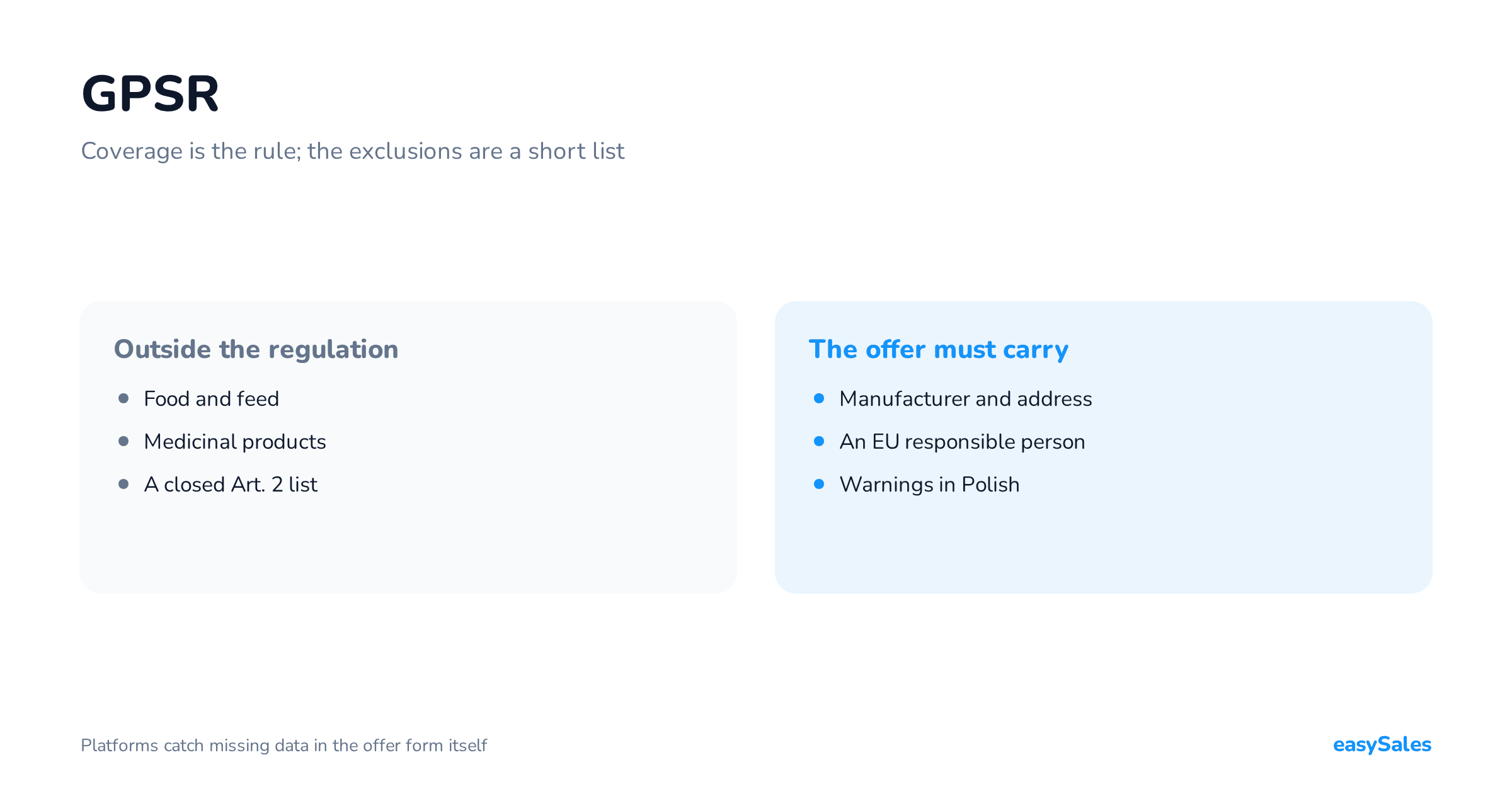
The first layer is the exclusion list in Article 2. It is closed, and it covers medicines, food, feed and antiques among others. Everything outside it is in scope.
The second layer concerns products for which Union law has already set its own safety requirements. Toys, cosmetics, construction products and medical devices have their own sector rules.
For those products the GPSR covers only the risks those rules leave out. That does not mean the offer is free of information duties.
Why that does not exempt the offer data
This is the most common misunderstanding in the whole topic. A toy seller concludes that toys have their own directive and leaves the GPSR fields empty.
UOKiK puts it differently: the requirements for online offers apply to all products, both those under harmonised legislation and those outside it, unless the sector rules already impose the same duty.
What data has to appear in the offer
This is the core of the topic and the reason most sellers heard of the GPSR at all. Article 19 lists four items that a distance offer has to carry clearly and visibly.

Manufacturer details
You publish the manufacturer's name, registered trade name or registered trademark, together with the postal address and the electronic address at which the manufacturer can be contacted.
An electronic address means an e-mail address or another channel that allows real contact, such as a form. UOKiK states plainly that the address of a static website is not one.
Product identification
Article 19 names a picture of the product, its type and any other product identifier. In practice that means the photo, the model, the type, the manufacturer part number and the barcode.
The barcode alone does not settle it. How the identifiers fit together is covered in our article on the EAN code.
Warnings and safety information
This means the warnings and safety information that, under the regulation or under sector legislation, have to appear on the product, on the packaging or in an accompanying document.
Where a product needs none, because it can be used safely without instructions, the field stays empty with a reason. That exception sits in Article 9(7) and covers things like a ballpoint pen.
The EU responsible person and when you need one
The responsible person is an operator established in the Union that is responsible for the tasks in Article 4 of Regulation 2019/1020 for that product. Without such an operator the product may not be placed on the market.
You publish those details in the offer only where the manufacturer is not established in the Union. With a Union manufacturer the field stays empty.

Who can take the role
Regulation 2019/1020 names the manufacturer established in the Union, the importer, an authorised representative appointed in writing, and a fulfilment service provider where none of the others is established in the Union.
The responsible person regularly checks that the product matches its technical documentation and carries the required marking. On request it gives the authority evidence that those checks were done.
Where nobody in the supply chain names a responsible person, marketplace practice pushes sellers into entering their own company. That is not filling in a field; it is taking on the duties and the responsibility for the product's compliance.
This bites hardest when goods come straight from a supplier in Asia. If you work in a dropshipping model, settle this point before the first order rather than after it.
Warnings and instructions in the local language
Instructions and safety information must be clear and in a language easily understood by consumers, as determined by the Member State where the product is made available. For the Polish market that is Polish.
The same condition applies to the text of the offer. If you sell on several markets, the safety information should be in the official language of each of them.

Two duties, not one
Marking the product and filling in the offer are two separate requirements. Meeting one does not close the other, which Allegro's own help page confirms: in distance selling, putting the manufacturer's details only on the label is not enough.
The reason is simple. The buyer is meant to see the data before deciding to buy, and will not see a label until the parcel arrives.
The QR code and the shortcut that fails
A QR code is allowed, but only as an addition. UOKiK writes that the basis is the information applied to the product, its packaging or a document accompanying it, and that a code may only make it additionally available.
The GPSR on Allegro and other marketplaces
Marketplaces did not invent these fields. Article 22(9) requires a provider of an online marketplace to design its interface so that a seller can supply exactly this information and a buyer can see it.
That is why the fields look alike in every panel, even under different names. The difference lies in what the marketplace does with an offer that is missing them.

Allegro
According to its help for sellers, manufacturer details, the responsible person and safety information are filled in under My inventory, one by one, in bulk, through the API or from a file.
Offers with gaps are found with the incomplete product data filter. Allegro also lists the parameters it marks as mandatory because of the GPSR, among them brand, manufacturer code, GTIN, product number, series, type and kind.
Kaufland
Kaufland Global Marketplace describes in its Seller University a GPSR report in the Seller Portal that shows a column with the reason for non-compliance. The data is filled in with automation rules, a CSV file or the API.
The consequence is stated outright: offers that do not contain the required contact details shall be systematically excluded from selling.
Amazon
Amazon's Seller Central help says that offers found not to meet the requirements will be deactivated, including where the information was submitted but judged inappropriate.
The same page lists the products in scope, including second-hand, repaired, refurbished and handmade goods, printed books and spare parts.
Several catalogues, one source of data
The operational problem is not filling in a field. It is that the same set of data has to reach every catalogue separately and stay consistent. We collected that in our article on running Allegro, Empik and Erli in one panel.
Reporting accidents and recalling a product
Article 20 imposes a duty to report an accident caused by a product. The report goes to the competent authorities of the country where the accident happened, through the Safety Business Gateway.
An accident means an event connected with the use of a product that caused death or serious adverse effects on health and safety, whether permanent or temporary.

Who files the report
An importer or distributor who learns of an accident informs the manufacturer without undue delay. The manufacturer then files the report, or instructs the importer or one of the distributors to file it.
Where the manufacturer is not established in the Union, the responsible person makes sure the report is filed. The Commission later publishes alerts about dangerous products on the Safety Gate portal.
Notifying the authorities does not replace informing the buyers. In a recall you have to identify every affected consumer and tell them directly.
Recall and the choice a consumer gets
A product safety recall requires a notice headed "Product safety recall", available in the languages of the markets where the product was made available.
Article 37 requires the consumer to be offered a choice of at least two remedies: repair, replacement with a safe product of the same type, or a refund of at least the price paid.
The consumer bears no shipping or other return costs. For products that by their nature cannot be moved, the economic operator arranges collection.
Technical documentation and what to keep
The manufacturer carries out an internal risk analysis and draws up technical documentation containing at least a general description of the product and its essential characteristics relevant to assessing its safety.
That documentation is kept at the disposal of market surveillance authorities for ten years after the product is placed on the market. The importer keeps a copy for the same period.
The manufacturer also keeps an internal register of complaints and a register of recalls and corrective measures. Personal data in the complaints register is kept for no more than five years after entry.
In Poland, general product safety is supervised by the President of UOKiK, and the controlling authority is the regional Trade Inspection inspector. The duties attached to each role are set out on biznes.gov.pl.
A GPSR checklist for a single offer
The order below is resistant to the most common mistakes, because each point closes the condition for the next.
Eight points to check before publishing
- Establish whether the product sits on the Article 2 exclusion list. If it does not, carry on.
- Establish your own role: distributor, importer, or manufacturer under a private label.
- Get the manufacturer's name, postal address and a working electronic address from your supplier.
- Check whether the manufacturer is established in the Union. If not, settle who the responsible person is.
- Fill in the product identifiers: picture, type, model, manufacturer code and GTIN.
- Prepare warnings and instructions in Polish, and in the languages of any other markets you sell on.
- Put the data in the offer, not only on the label. Treat a QR code as an addition.
- Run the incomplete-data filter in your panel and clear the backlog before the next publication.
The third point is the only one whose timing you do not control. If the supplier goes quiet, what is left is asking the importer or the distributor through which the goods entered the Union.
One closing caveat. This article describes what the regulation and the marketplaces require, not the situation of your product. Settle the scope of sector rules, the safety assessment and the question of liability with your own legal counsel or compliance adviser.