Allegro, Empik and Erli in one panel
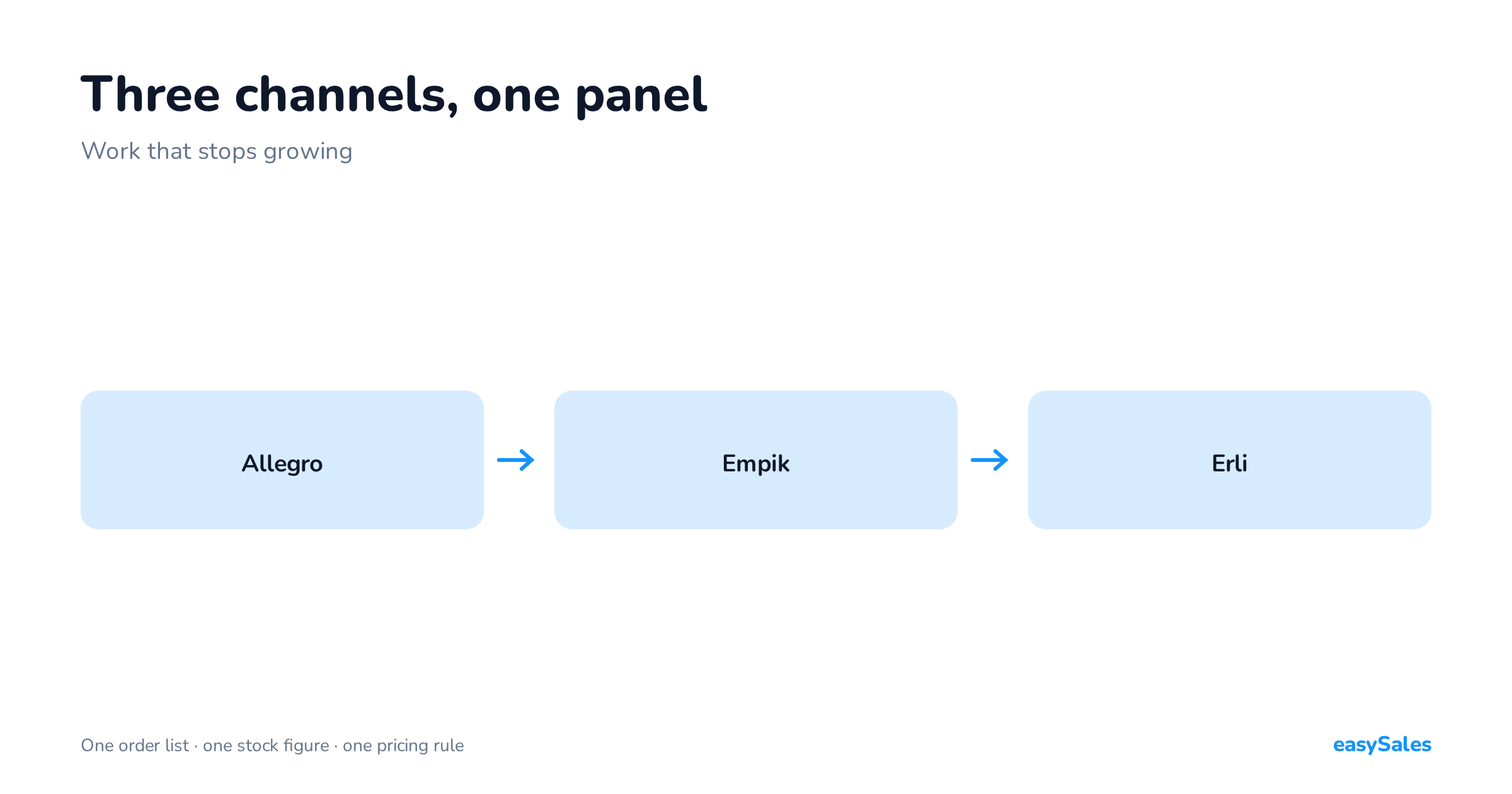
A second and third channel cost whatever running them costs. What has to be in order before you add another marketplace — and what stops growing once it is.
The case for a second channel is obvious: the same goods, more buyers, less dependence on one platform.
The case against is equally obvious and usually wins — the workload grows. A second panel, a second order list, a second set of labels, a second place to watch stock.
The whole difference is whether work grows with the number of channels or not.

What has to be in order first
A catalogue with sensible SKUs
This is the one genuinely hard requirement. If the same product has a different identifier in every channel, no synchronisation has anything to anchor to. Sorting it out before adding a channel takes a day; afterwards, a week.
One stock figure
Not "Allegro stock" and "Empik stock" but a stock level every channel reads. With two channels, duplication is still survivable. With three it ends in overselling.
Prices by rule, not by list
Every marketplace has different commission, so the price has to be derived per channel.
Maintaining three price lists by hand works right up until the first change in delivery costs.
One stock level read by every channel is a condition, not an improvement. Without it, each additional channel increases oversell risk.
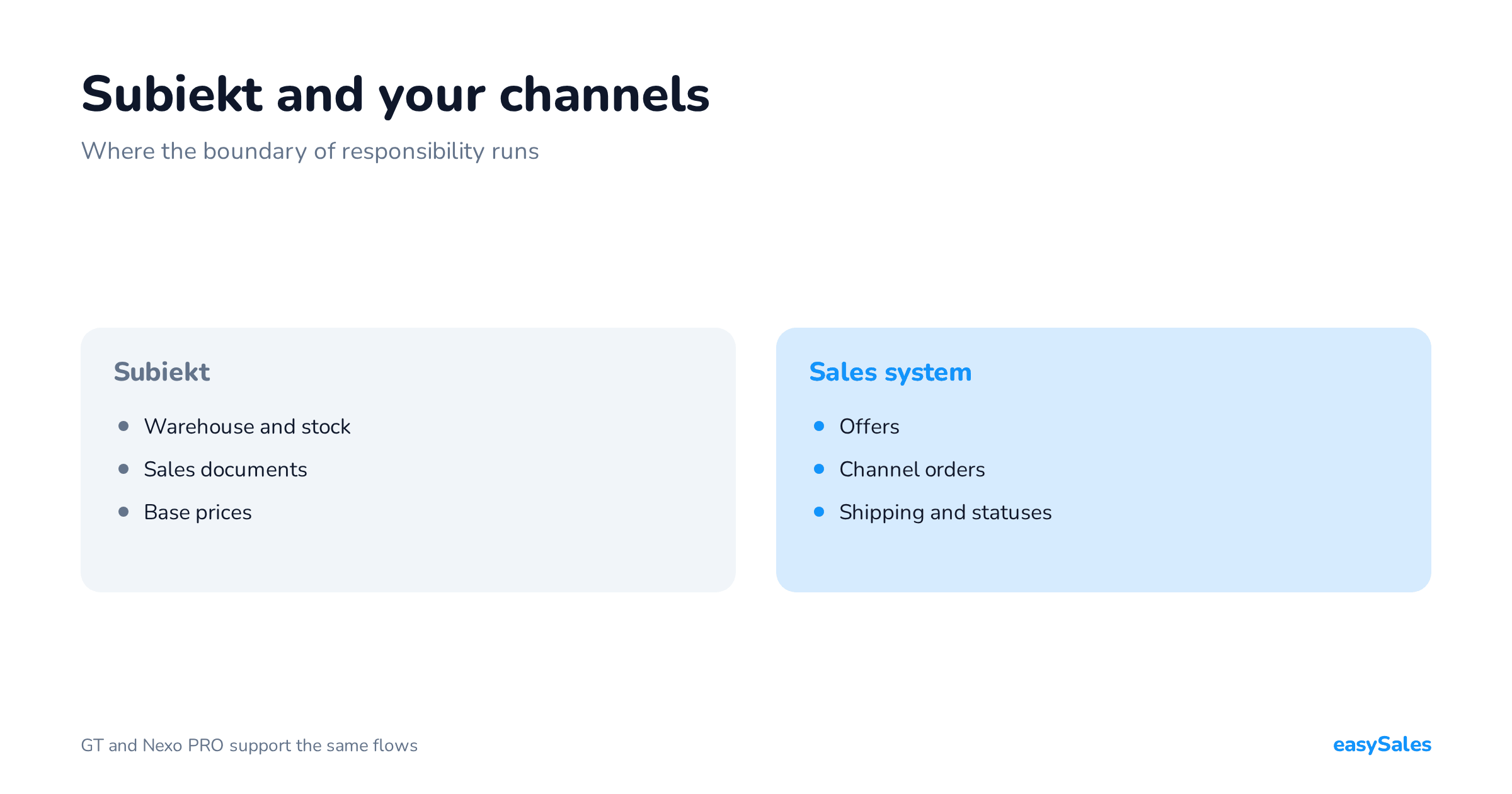
Separate pools make sense only when you physically have separate warehouses — not when it simply ended up that way.
What stops growing
Once that is done, adding a channel stops being a project and becomes a setting. Orders land in the same list. Labels print in the same batch.
Invoices are created by the same rule. Whoever packs does not need to know which platform an order came from — and that is the real test of whether an integration works.
One process, many channels — what that looks like in practice

"Orders land on the same list" reads like a slogan, so it is worth spelling out what it means on an actual working day.
Morning. You open one order list. There are no per-channel tabs, there is a source column.
You filter by "to pack" rather than by platform, because from a packing point of view it does not matter where the order came from.
Packing. You select orders and print labels in one batch — across all channels at once, and across different couriers if that is what the chosen delivery implies.
The person packing gets a picking list on which an Erli item and an Allegro item look identical.
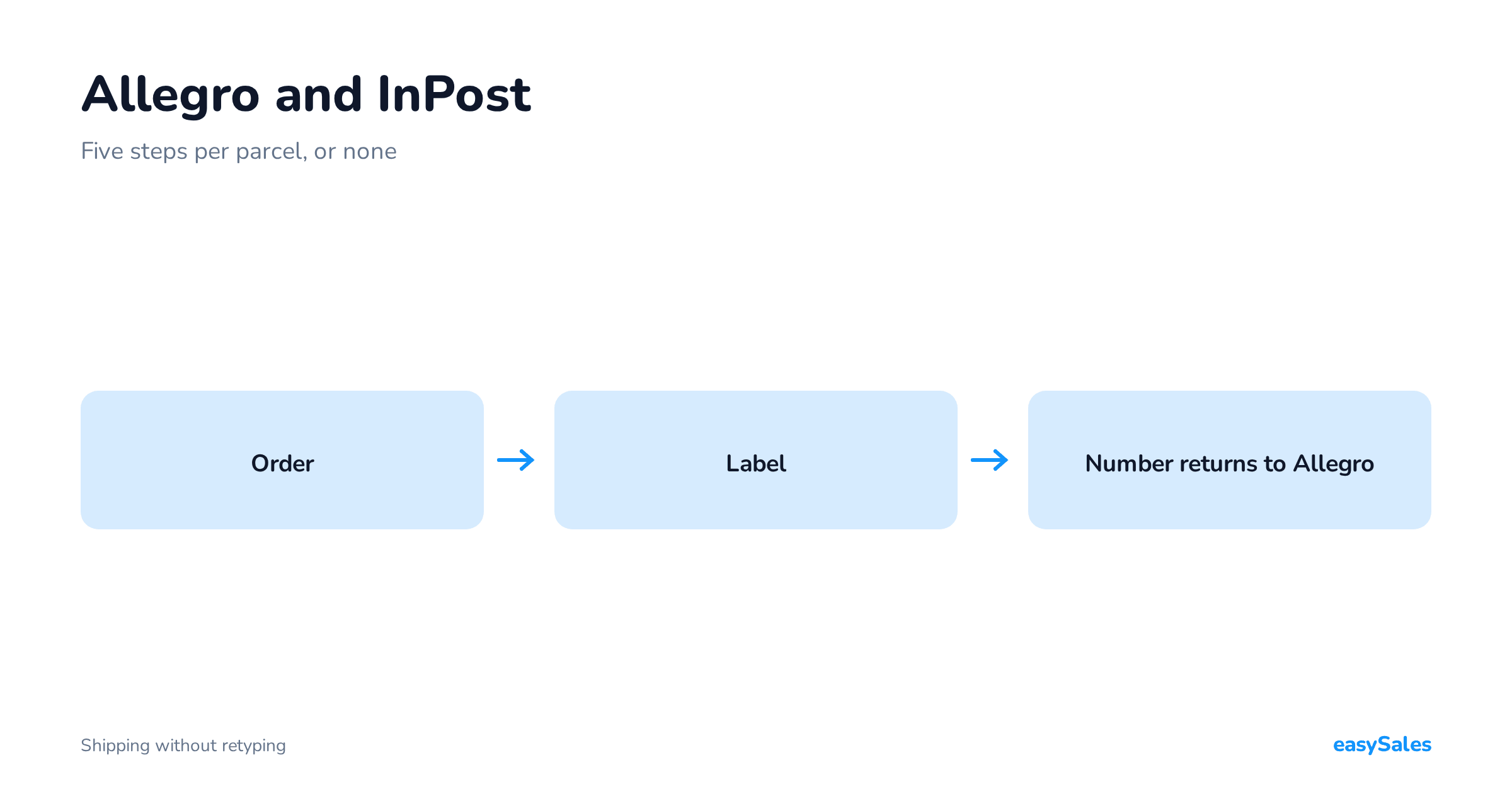
Dispatch. Tracking numbers go back to the right platforms automatically. This is the moment where the difference between channels exists again — but the system handles it, not you.
Documents. Invoices are created by the same rule, in the same accounting program, under one numbering series. At month end you have one statement rather than three to reconcile.
Evening. Stock has updated across every channel from a single source. There is no "reconcile stock" task, because there is nothing to reconcile.
The test is simple and tells you more than any specification: ask the person who packs which platforms today's orders came from. If they do not know and do not need to, the process is shared.
If they do know, because they work in several places, the channels were parked next to the process rather than wired into it.
The most common mistake: a channel parked beside the process
This scenario is worth naming outright, because it is very common and looks harmless for a long time.
A seller connects a new channel but keeps its own panel "for now" for some tasks — because messages are easier to read there, because listing is quicker there, because that is how it started.
A month later some orders are handled in the system and some in the platform panel, and nobody is quite sure which are where.
The symptoms are recognisable: stock occasionally needs "fixing by hand", some orders get handled twice or not at all, and at month end the platform's numbers do not match the system's.
None of that is an integration fault — it is the result of two parallel processes running on the same data.
The cure is uncomfortable but effective: once a channel is live, stop opening its panel for operational work. The platform panel stays for the things the system does not do — disputes, settlements, account settings.
Everything concerning an order happens in one place. That habit decides whether your third channel costs as much as the first, or almost nothing.
Integrating Erli step by step: what actually has to happen

Adding a channel stays abstract until you break it into tasks. An Erli integration consists of four things, and only one of them genuinely takes time:
Connecting the account
Authorisation and basic seller settings. Fifteen minutes, and the only part that looks like "integration" in the everyday sense.
Category mapping
Your categories have to be assigned to Erli's category tree.
This is not translating names — it is deciding where in someone else's catalogue your product should stand, because that determines who finds it.
With a dozen categories it is an hour. With several hundred, start with the ones carrying most of your turnover and add the rest later.
Characteristic mapping
Each category has its own set of parameters, and some are mandatory.
This is where the real cost of adding a channel sits: not in the connection, but in filling in product data you never needed before.
The good news is that this work does not evaporate — attributes completed for one channel usually serve the next one too.
Delivery and pickup points
Erli supports delivery to collection points, so the buyer's choice has to reach the waybill.
That is a setting rather than manual work — provided the courier is connected to the system rather than handled separately.
To summarise the proportions: connecting takes minutes, category mapping takes hours, completing attributes takes days — and only the last one needs planning.
Anyone assuming an Erli integration is just clicking "connect" usually stalls precisely at the attributes.
Empik: same mechanics, different profile
Empik works on the same mechanics — connection, categories, parameters, delivery — so once you have one channel behind you, the second is a repeat of a familiar pattern rather than a new project.
The difference is in the buyer profile and in which categories make sense there. Empik has strong categories built around its own history, while Erli is broader and competes harder on price.
So the same range can behave completely differently on the two, and it is not safe to assume that something selling on Allegro will sell everywhere.
The practical consequence: do not list everything on both. Start with a narrow group, see what sells, and expand on results rather than on catalogue size.
A complement, not a replacement
Both are smaller than Allegro, and that is their advantage rather than their drawback — less competition in categories where on Allegro you are one of many.
Treat them as added volume, not as a replacement. The sensible order is: get the main channel in order first, then add another without changing how you work.
Products stay single. Channels read from them what they need — you are not building a second catalogue.
Only the data a given platform requires is channel-specific: the category and some parameters. Those attach to the product rather than duplicating it.
Prices work the same way.
The channel price is derived by rule from the base price, so the difference between Erli and Allegro is the result of a setting rather than manual work on every offer.
And documents too: same rule, same accounting program, same numbering. A new channel should not be a reason to start a separate invoice flow.

What a channel costs — in time, not in subscription
A channel's cost has three components, and only the first appears on a price list.
Commission — known upfront and easy to calculate. It goes into the pricing rule and stops needing attention.
Launch — one-off: category mapping, completing attributes, delivery settings. This is the cost people underestimate, because it is work on data rather than on configuration.
With a tidy catalogue it is a day or two. With a catalogue that has never been tidied it is a week, and that is normal.
Ongoing handling — and this is where the whole bet sits.
If the channel joins the same process as the others, the ongoing cost is close to zero: orders land on one list, labels print in one batch, invoices are created by the same rule.
If the channel has its own panel and its own rhythm, the ongoing cost is linear — every additional hundred orders is another few hours.
Which is why "is Erli worth adding" is the wrong question.
The right one is: is my process ready for another channel to change nothing about it. If it is, adding channels is cheap and can be done calmly.
If it is not, every channel costs the same as the first, and after the third the retreat begins.
Which products to list on a second channel

Instinct says "all of them" — the integration works anyway, so what difference does it make. It makes a difference in three places.
- Low-margin products. A new channel's commission can eat what is left. Do the arithmetic before listing — from purchase cost, not from your Allegro price.
- Data-hungry products. A category with twenty mandatory parameters against two units sold a month is a poor use of time. Start with categories where listing is cheap.
- Fast-moving products held in low stock. The faster something sells and the less of it you hold, the greater the oversell risk from an extra channel. That is not a reason to skip listing — it is a reason to have one shared stock level and a buffer first.
A sensible start is a few dozen well-rotating items with complete data. After a month you will see whether the channel sells in your category at all — and only then is it time to decide about expanding, rather than the other way round.
How long a second channel takes to launch
Worth setting expectations, because the gap between "hours" and "a week" comes down to one factor.
Connecting the account and basic configuration is hours. That part is predictable and looks the same for everyone.
The real timeline is set by how complete your product data is. With categories and parameters filled in, days. Without them, a week of work on the catalogue.
That work does not evaporate. Attributes completed for Erli mostly serve the next channel too, which is why the second channel after the first is markedly cheaper.
Returns from a new channel follow the same path as the others: acceptance, a correction in the accounting program, stock back in.
The one thing to check before launch is whether your accounting program copes with a partial return — that limitation concerns documents, not the channel.
And one last thing you only see with shared stock: when an item runs out, the offer drops to zero across every channel at once.
Running out stops being an event you handle in several places.
Three signs a channel has not worked

Withdrawing from a channel is a normal decision, not a failure. It is only worth making on data rather than after two quiet weeks:
- There are sales, but margin after commission is negative. The easiest case: the pricing rule was set wrong and the channel is selling below the floor. That is fixed, not closed.
- There is traffic but no sales. Usually it means you are competing on price in a category where you have no cost advantage. Worth checking whether it affects the whole range or a handful of lines.
- Neither traffic nor sales, after three months. Only this is a signal that the category simply does not live there. Three months is the minimum, because the first weeks on a new account always look weak.
If you do withdraw, disable the offers rather than deleting them. Relisting in six months costs as much as the first time — and the data you completed then will still be valid.
If you handle Erli orders differently from Allegro orders, the channel was parked beside the process rather than wired into it.
That is exactly the scenario where work grows with the number of channels — and the only reason a third channel costs as much as the first.
When not to add one
The sequence that decides it
If you handle one channel manually today and it works, adding a second will not double the difficulty — it will do worse, because context switching is added on top.
Automate first, expand second. The other way round almost always ends in a retreat.
The Empik integration · the Erli integration · all integrations