Dropshipping: how it works and what you answer for
Dropshipping is a model where the supplier ships straight to the buyer. See how it works, whether it is lawful, and which duties stay with you.
Dropshipping is a sales model in which the supplier ships the goods straight to the buyer and you never hold them yourself.
You run the listing, take the order and take the payment, while a wholesaler or a manufacturer picks and dispatches the parcel.
This article covers how the model works step by step, what Polish law and the marketplaces attach to the role of seller, and where dropshipping usually falls apart.
What dropshipping is
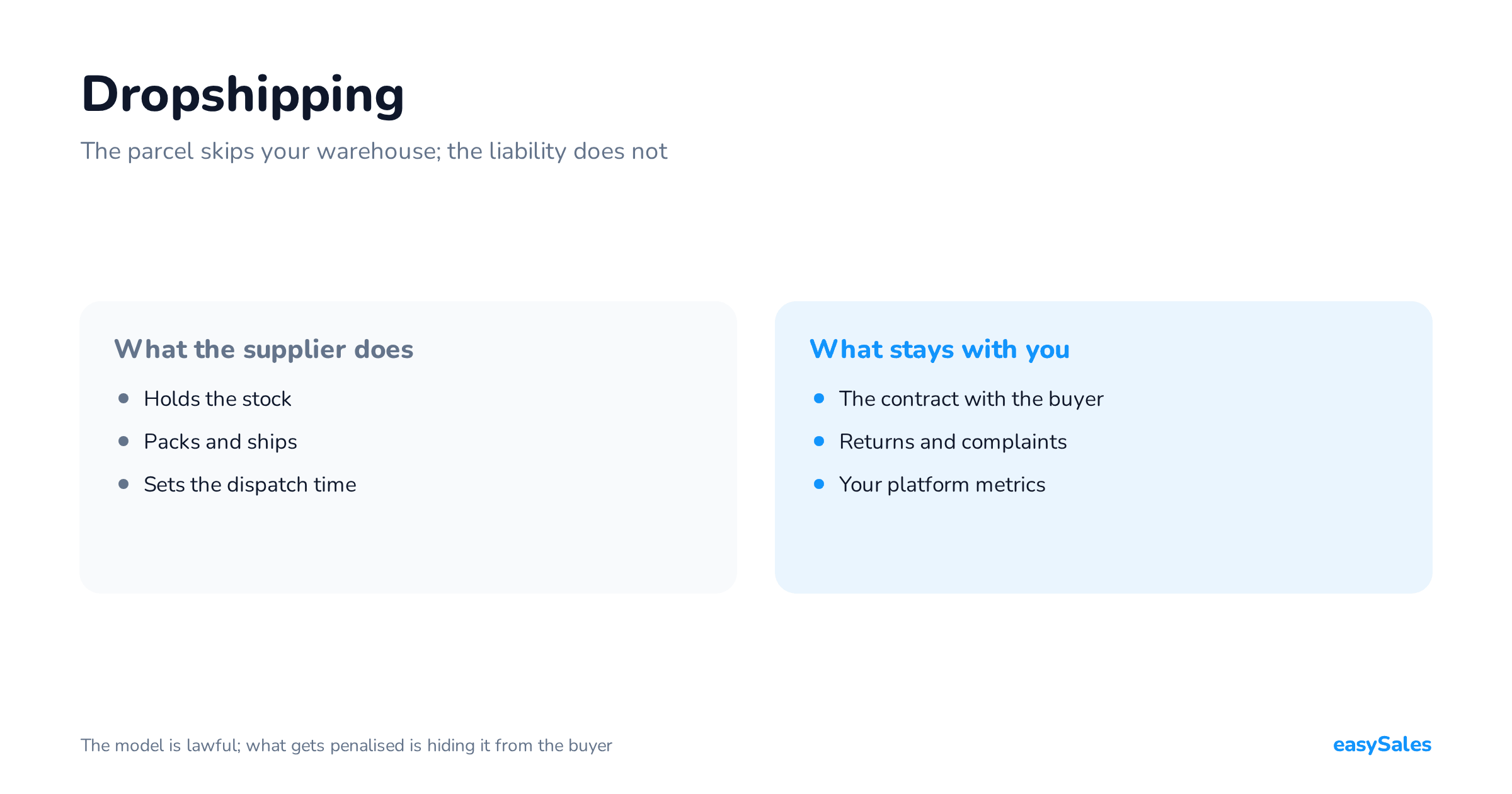
The name describes logistics, not the contract. Moving dispatch to the supplier does not move your duties towards the buyer with it.
Poland's consumer authority, UOKiK, describes the model in one sentence: an intermediary runs the website and the buyer acquires the goods directly from another entity. It attaches a condition we come back to below.
The seller has to be named on the site, together with what the seller answers for and what the intermediary answers for. That comes from UOKiK's communiqué on high-risk purchases.
How it differs from ordinary selling
In ordinary selling you buy the goods, keep them yourself and ship from your own warehouse. The risk sits in the stock: you bought it, so you have to sell it.
Dropshipping has no such risk because it has no stock. What replaces it is execution risk — you promise something whose execution you hand to somebody else.
How it differs from fulfilment
In fulfilment the goods are yours and they sit in someone else's warehouse. The operator packs and dispatches, but the stock level is yours and you know how much is left.
In dropshipping the goods are not yours until the sale, and you see the stock level only as many times a day as you manage to fetch it. That is one of the two differences that decide everything below.
How dropshipping works step by step
One order's path has four steps on your side and ends where the parcel and the liability head in opposite directions.

- You publish the listing using the supplier's data and photos.
- The buyer places and pays for the order with you.
- You pass the order to the supplier — by file, through a panel or over an API.
- The supplier picks the parcel and dispatches it to the buyer's address.
- The tracking number comes back to you, and you pass it to the marketplace.
What happens on the supplier's side
The supplier orders its own dispatch queue. Your order competes with the orders of every other shop buying from the same warehouse.
That is precisely where the gap opens between the time you declared in the listing and the time the parcel actually moves.
Where this path usually breaks
Steps three and four are the only places where anything goes wrong. Step three breaks when the stock is gone, and step four when the supplier dispatches later than you promised.
Is dropshipping legal in Poland
Yes. UOKiK states plainly that dropshipping is a lawful business model provided consumers are not misled.
What is unlawful is not that somebody else ships, but that the buyer does not know it.

What a seller was fined for
In 2023 the President of UOKiK imposed more than PLN 100,000 on the company behind bigotka.pl and arkadie.pl. The case is set out in the communiqué on the fake countdown timer.
The sites presented themselves as a clothing shop while to a large extent they were limited to intermediation. Consumers found out only at the point of withdrawing from the contract.
At that point it turned out the goods had to go back at their own cost directly to the manufacturer, most often based in China. The second charge concerned a promotion timer that restarted every day.
The penalty here fell on the absence of clear information about the model and about the address goods return to, not on the model. Terms that say nothing about a return to Asia are the commonest version of the same mistake.
What registration and terms require
Registration rules are no different for dropshipping than for any other online selling. The thresholds, forms and exceptions, unregistered activity included, are set out on biznes.gov.pl.
If you run your own shop, you make your terms available to the buyer free of charge before the contract is concluded. In the intermediation model those terms are what settles who sells and where the goods go back.
Two models: intermediation or selling on your own account
This distinction decides everything below it, and most guides skip it. You pick it through your contract with the supplier and the wording of your own terms.

Under intermediation the supplier is the seller and you provide a service. Selling on your own account means you buy the goods and resell them, even though you never see them.
The tax consequences of each model are a separate subject and stay outside this article. Settle them with your accountant before you publish the first listing.
What dropshipping means for a seller's duties
Every duty below attaches to the party to the contract with the buyer. If that party is you, they attach to you, whoever dispatches the parcel.
Information before the order
By the time the buyer expresses the intention to be bound by the contract at the latest, they have to know the seller's identifying details, address, email and a phone number for fast contact.
Added to that are the total price with taxes, the manner and time of performance, and the complaints procedure. The full list is collected by UOKiK for distance selling.
The deadline for handing over the goods
The goods should be handed over without delay and no later than 30 days from the conclusion of the contract, unless something else was agreed. Past that point the buyer sets an additional period and may then withdraw.
Operating and maintenance instructions in Polish go to the buyer along with the goods. UOKiK cites as the basis articles 546 and 546¹ of the Civil Code.
Polish-language instructions are the condition you learn about last when the goods come from Asia. The parcel goes straight from the supplier, so there is no moment at which you could add a leaflet.
Parcel risk and product safety
The seller bears the risk of accidental loss or damage in transit until the buyer receives the parcel. A seller cannot disclaim that liability in the shop's terms, even where a carrier caused the damage.
The complaint goes to the seller, and the seller pursues the carrier. The basis is article 548 paragraph 3 of the Civil Code, explained on the page on liability for the parcel.
Product safety supervision runs separately. A distributor has to check the product before making it available to consumers, and must not make it available while labelling, instructions or warnings are missing.
That duty does not disappear because you have never seen the product. UOKiK sets out the roles on its page about traders' obligations.
The downsides you find out about later
The upsides of dropshipping are described everywhere: no stock, a low barrier to entry, a wide assortment. Below is the list of things those descriptions mention less often.
- A supplier's stock-out turns into a cancellation on your side.
- The dispatch time depends on a queue you cannot see.
- An order from two wholesalers arrives in two parcels on two dates.
- A return comes back to you or to the supplier — and that has to be written down in advance.
- Your descriptions and photos are the same as every other shop the supplier serves.
- A slip with the wholesaler's logo in the box reveals a model you never announced.
Split shipments and what they cost
A buyer who paid for one delivery expects one parcel. With two wholesalers you cover the second dispatch out of your own margin, and the two delivery dates count against your metrics separately.
The supplier's stock levels against your listing
This is the only problem in the model that a technical fix solves. The rest takes a contract or money.

The gap between imports is the whole stake
Fetch stock once a day and you sell against yesterday's numbers. Fetch it every quarter of an hour and the overselling window shrinks to a quarter of an hour.
The frequency depends on what the supplier exposes: a CSV file on a server, an XML feed, or an API returning stock on request. Ask about that before you ask about prices.
A safety buffer and the zero threshold
The second mechanism is a buffer: you hide the listing once the supplier is down to a few units. It costs you the sales on the last units and buys you quiet metrics.
What a listing system has to handle in that scenario is taken apart in our article on what an Allegro integration must do.
Dropshipping on Allegro and other marketplaces
Marketplaces do not ban the model and do not ask who dispatches the parcel. They hold you to what you declared in the listing yourself.

Allegro measures what you do, not what you declare
Allegro builds the estimated delivery time from two inputs: your declaration in the listing and real data on how fast you actually dispatch. It works from the last 90 days at most, as its help for sellers explains.
In the My Sales Quality panel the On-time dispatch metric runs from minus 460 to plus 40 points, against a 400-point maximum for the whole panel. The scoring is published on the page about how points are awarded for each metric.
The largest reward in that panel, up to 160 points, is available only on listings declaring immediate or one-day dispatch. With a supplier that runs a queue, you usually cannot make that declaration.
Kaufland and the refund approved automatically
Kaufland Global Marketplace sets the default withdrawal period at 14 days and free return shipping on orders above PLN 175.
If you do not handle a return within three working days of the parcel reaching your warehouse, the system approves the refund to the buyer by itself. That is how Seller University describes it.
The same catalogue on several marketplaces
Every marketplace has its own fields, its own metrics and its own deadlines, while the supplier's data is a single set. How to keep that consistent is covered in our article on running Allegro, Empik and Erli in one panel.
Returns and complaints in dropshipping
This is the part that decides whether the model survives. The deadlines run on the seller's side and they do not stop at the supplier's warehouse door.

The refund and what it covers
The seller returns all payments without delay and no later than 14 days from receiving the withdrawal statement. Payment may be withheld until the goods arrive or proof of their return is provided.
What goes back is the price plus delivery up to the cheapest option available in that listing. Direct return costs fall on the buyer, unless the seller agreed to cover them or failed to mention them.
UOKiK sets out these rules in its sections on the effect of withdrawal and on costs.
A complaint goes to the seller
Where goods do not conform to the contract, the liable party is the seller and the complaint letter goes to the seller. A seller cannot refuse to accept a complaint unless the law expressly allows it.
That liability is mandatory and covers all goods, as the page on non-conformity confirms. On Allegro the basic period of that liability is 2 years on every market.
Platform deadlines run separately
For a withdrawal, Allegro allows 7 calendar days from the return parcel's status changing to delivered, but no later than 14 days from receiving the buyer's return form. Those are collected in the returns policy for sellers.
None of those deadlines waits for the supplier's decision. So the return address and the person who inspects returned goods have to be settled before the first sale, not after the first return.
How to choose a dropshipping wholesaler
Run the conversation with a supplier in the reverse of the intuitive order. Price lists come last, because without answers to the questions below you cannot use one anyway.
- In what format and how often do you expose stock levels?
- Does the stock level show units, or only an availability flag?
- What is the cut-off time for same-day dispatch?
- Is there any document with your details inside the parcel?
- Which address do goods return to after a withdrawal, and who pays the postage?
- Who supplies manufacturer data, warnings and the GTIN for the catalogue?
- Are Polish-language instructions in the box, or do I have to supply them?
- What happens to an order when the stock runs out after you accepted it?
Check the answer to point four yourself, by buying one item from the supplier to your own address. It is the cheapest test in the whole process.
How much you can earn from dropshipping
We will not give margins or ranges here, because any such number would be invented. Instead we show what comes off the price and in what order — you work out the rest on your own price list.

What you do not set yourself
Of the seven items in the figure you set one. The supplier raises the purchase price, the marketplace changes the commission, and buyer behaviour sets the cost of returns.
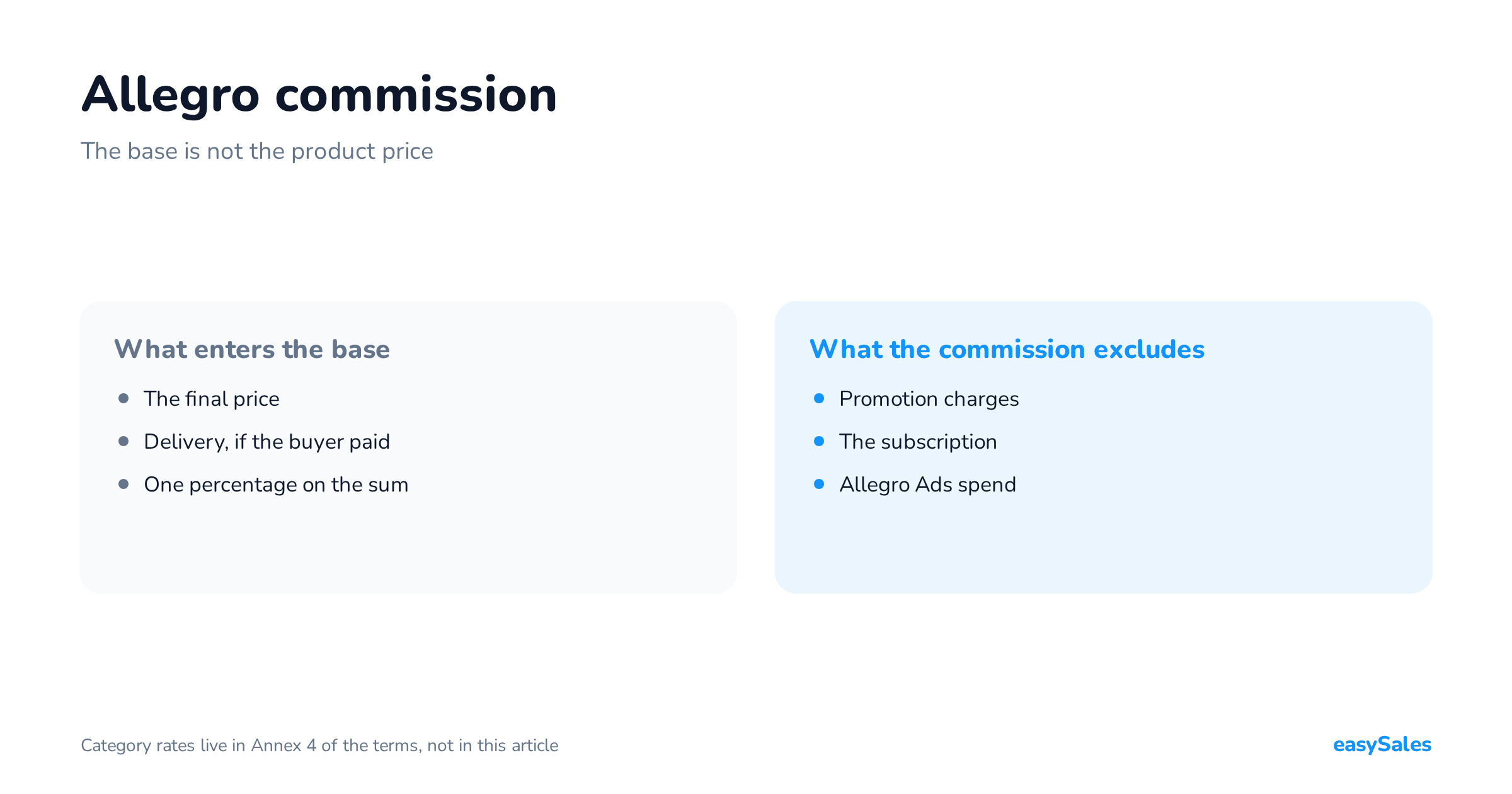
Allegro's own charges are published in its section on fees and commissions. The platform publishes them as a schedule, so you can work them out before the first sale.
Item six is the one usually left out
Your own time retyping orders, watching stock and answering questions about delivery dates appears on no invoice. It grows in a straight line with the order count, and the margin per unit does not.
What that handling really costs under different charging models is taken apart in our article on what order handling really costs.
Where to start
The order below is resistant to the commonest mistakes, because each point closes the condition for the next one.
Eight steps before the first listing
- Decide whether you are an intermediary or the seller — and write it into the contract with the supplier.
- Write terms that repeat that decision, and name the return address in them.
- Establish in what format and how often you will receive stock levels.
- Set the buffer below which the listing hides itself.
- Declare a dispatch time based on the supplier's queue, not on its promise.
- Buy one item to your own address and see what is in the parcel.
- Settle who receives a return and who assesses the condition of the goods.
- Collect manufacturer data, warnings and catalogue codes from the supplier.
Point one is the only one that cannot wait. Everything else follows from who you are, in that transaction, to the buyer.
One closing caveat. This article describes the model, UOKiK's position and marketplace rules, not your company's situation — settle your form of taxation and the treatment of purchases from your supplier with your accountant.