EAN code: what it is, where to get one, when it is required
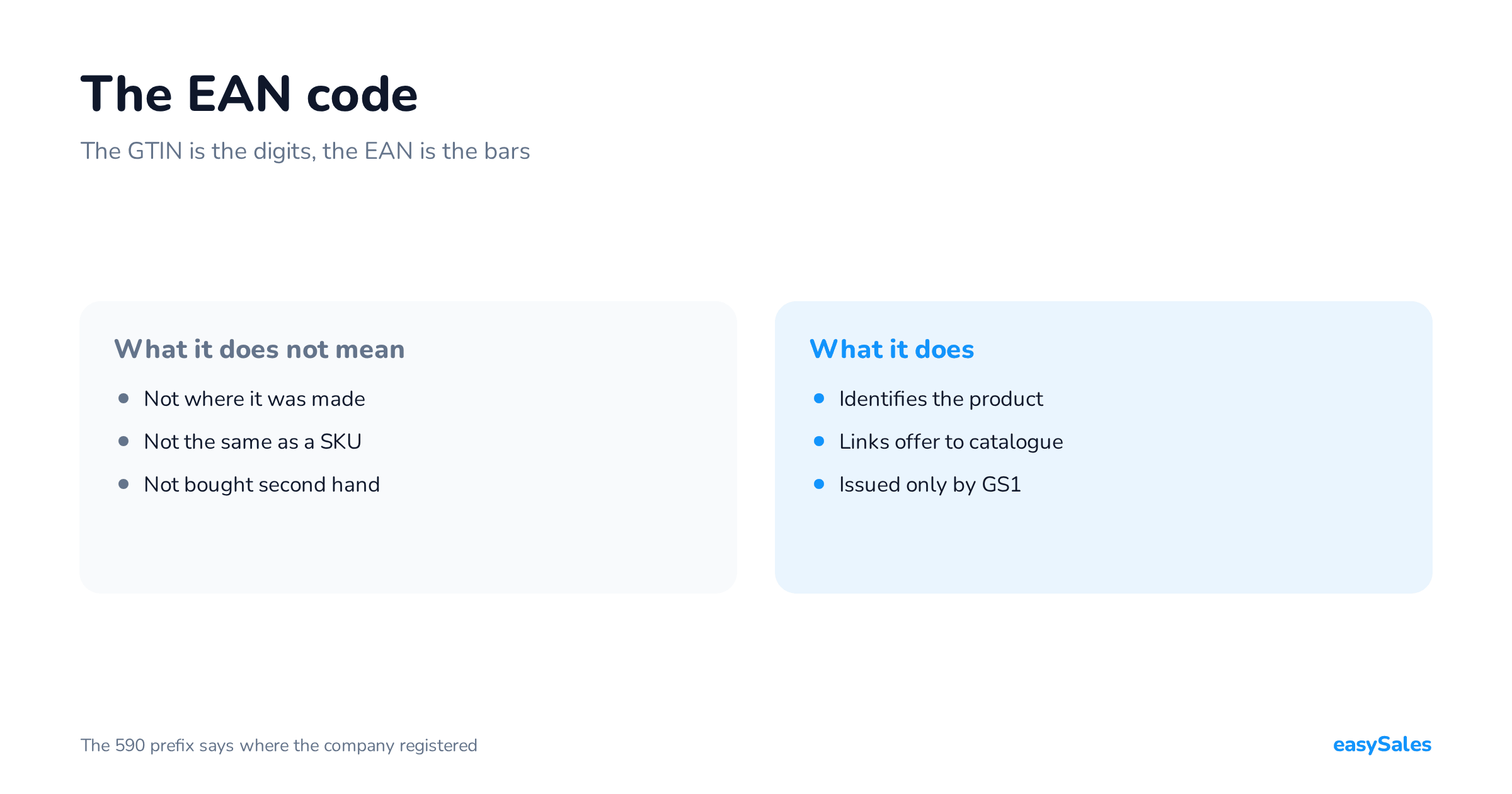
An EAN code is the bars; a GTIN is the digits — and the digits decide whether your offer links to the catalogue. The number's structure, the GS1 rules, what each platform requires, and the trap in second-hand codes.
An EAN code is a barcode that carries a GTIN — a Global Trade Item Number. GTINs are issued by one organisation only: GS1.
GS1 Polska draws the line in four words: EAN is the bars, GTIN is the digits. In practice everyone uses the two names interchangeably.
Below: what each digit means, where to get a number, how the fee is calculated, where an EAN code is required, and why resold codes fail marketplace verification.
What an EAN code is
An EAN code is one of the GS1 barcode symbologies. The bars themselves identify nothing — the product's identity sits in the GTIN encoded inside them.
The same number can be rendered in another symbology, for instance as an ITF-14 on a case. That is why the shorthand "EAN means GTIN" misleads.

EAN code, GTIN and barcode — three different things
A GTIN is a string of digits assigned to a trade item. An EAN code is the artwork a scanner reads. Barcode is the wider category, covering other symbologies too.
GS1 counts four codes in the EAN/UPC family: EAN-13, EAN-8, UPC-A and UPC-E. Each is built from a GTIN of the matching length.
Why the distinction matters when you list
The listing form does not take an image. It takes digits. A product catalogue matches your offer on the number, not on the artwork printed on the pack.
Allegro calls the field "GTIN number (EAN code)" and states that the number has 8, 12, 13 or 14 digits, most often thirteen in Europe. You will find it under the barcode.
What an EAN-13 number is made of
A GTIN-13 has four parts: the GS1 prefix, the company number, the product number and the check digit. The boundary between company and product moves with the pool size.

The 590 prefix is not a country of manufacture
The first three digits name the GS1 organisation the company joined. Companies registered with GS1 Polska receive the prefix 590.
GS1 says so plainly in its FAQ: this is not information about where the product was made. A product numbered from 590 could have been made anywhere.
A Polish company can register with GS1 Polska, but GS1 also allows a national organisation in another EU country to admit it. So a Polish manufacturer may hold numbers with an entirely different prefix.
The check digit and why you would calculate it
The last digit is derived from the others and exists to confirm the number was copied correctly. The algorithm is published in the GS1 General Specifications.
If you are moving numbers off a supplier price list into a spreadsheet, the check digit catches the typo before it reaches your catalogue. GS1 Polska publishes an online calculator.
EAN-13 and EAN-8 — when the short one is used
EAN-8 is not a version you choose. You get one only by showing that an EAN-13 physically does not fit on the packaging.
GS1 Polska publishes hard thresholds: a printable pack or label area no larger than 40 cm², or a round pack no more than 3 cm across.

The application must include a photograph and the product's dimensions, so that EAN-13 can be ruled out. GTIN-8 numbers are allocated one at a time, not in pools.
Where to get an EAN number
GTINs come from a single source: a GS1 organisation. Registration gives a company the right to use its own GS1 company prefix, and from that you build numbers for your products.
Who assigns the number — the maker, the importer or you
GS1 calls that party the GTIN allocator: whoever is answerable for the item's declarations, such as the label information. For a branded product that is the brand owner.
An importer or wholesaler can be the allocator too — if it sells the product under its own brand or alters it, for example by repackaging. So can a retailer selling under its own brand.
If you sell somebody else's brand, you do not assign numbers. Allegro puts it directly: do not add further GTINs for branded products whose brand you do not own.
Where you take stock from a supplier, the numbers arrive with the product. What that looks like from the selling side is covered in our piece on dropshipping.
Registration step by step
- Count how many numbers you need — variants, not models.
- File the application online: you will need a tax number, contact details and revenue.
- Pay online or by transfer against a proforma invoice.
- Assign the numbers to your products in the MojeGS1 platform.
- Download the membership certificate — selling platforms may ask for it.
GS1 Polska states that registration takes up to three business days from the application and the payment clearing. A registered number appears in the database within a day.
What an EAN code costs
The fee has two parts. A one-off joining fee follows the size of the number pool, and an annual fee follows the company's total net revenue for the previous year.
We do not quote amounts here, because the price list is approved by the GS1 Polska Council and gets updated. Current rates for both fees are in the GS1 Polska price list.
It is a licence, not a purchase
The annual fee comes back every twelve months from the date you joined. A further pool can be ordered at any time, once most numbers from the first one are registered.

Miss the payment for the following year and you lose the right to use the numbers allocated to you. With it goes the right to sell the products they label in retail chains and on marketplaces. That is GS1 Polska's own wording.
Is an EAN code mandatory on marketplaces
No regulation obliges a Polish seller to label goods with an EAN code. The obligation comes from product-catalogue rules, and those differ from platform to platform.

Allegro — a required parameter in half the categories
GS1 Polska states that a GTIN is a required parameter in half of Allegro's product categories. That is not the whole answer, though.
The consequence of not linking an offer to the Catalogue matters more. Allegro says it may end such an offer automatically, and without the link you cannot publish it on its foreign markets.
The GTIN is also the first search field in the listing form. If you have no code, you pick "My product has no GTIN (EAN)" and search the catalogue by name instead.
When you can list without an EAN code
Allegro allows listing without a number for things that never had one: handmade goods, unique collectibles, antiques. The parameters then have to be filled in properly.
The exceptions also cover its classified-ad categories — vehicles, property and services. Kaufland Global Marketplace runs the other way: the ean attribute is mandatory in every category.
Second-hand EAN codes
You can buy a "lifetime EAN code" online for the price of a coffee. Those numbers come from pools resold by companies that once registered with GS1.
The problem is straightforward. The exclusive right to allocate company identification numbers belongs to the GS1 organisation, and transferring a number to another entity requires a new contract.
A marketplace does not check this as you list. It checks later, by querying the GS1 product database — and that is when the offer stops working.

What the platform does with an unlicensed number
EmpikPlace verifies seller product data against the GS1 database continuously. If the number's status shows the code is invalid or illegal, the product is hidden in the catalogue.
Allegro warns that numbers sourced outside GS1 may belong to other products. Offers then link to the wrong pages, customers see inconsistent data, and the offer can be ended.
You already have products on non-GS1 codes — how to fix it
- Check every number against the GS1 database and list the ones missing or unlicensed.
- Register the company with GS1 and assign numbers from your own pool — for brands you own.
- Complete the product data in the MojeGS1 register so the items appear in the product database.
- If your number is attached to somebody else's product in a catalogue, report it and attach your GS1 certificate.
How to check an EAN code
GS1 Polska runs a code and product search built on its own product database. It answers three questions at once.
- Whether the GTIN is valid and came from a GS1 organisation.
- Which product it has been assigned to.
- What the manufacturer or brand owner's details are.
The database connects to the GS1 Global Registry, so it covers products worldwide rather than only Polish ones. GS1 puts the count above 650 million items.
A product missing from the database does not yet mean the number is illegal. Product data is entered by the brand owner in MojeGS1 — if that was never done, the number may be licensed and the product simply invisible.
EAN code and SKU — two different jobs
An SKU is your internal stock number. You assign it yourself, it applies only inside your own systems, and nobody outside your company has to understand it.
A GTIN works the other way round. It is global, unique and recognised by every trading partner. One field will not stand in for the other, though both sit on the same offer.
The three identifiers people mix up
- GTIN (EAN code) — the global product number, from a pool licensed at GS1.
- Manufacturer code — the maker's catalogue number, any string of characters.
- SKU — your own stock number, outside any standard.
Allegro treats the manufacturer code as a separate parameter and warns explicitly against confusing it with the GTIN. The two fields are filled in independently.
Why offers fail to link to the shop catalogue
Connecting a shop catalogue to marketplace offers means naming a shared key. Usually that is the SKU or the GTIN — and this is where the trouble starts.
If the shop holds only SKUs and the offers only GTINs, or one side leaves the field empty, no match is made. What is left is manual work in a spreadsheet.
So before you connect another channel, put both fields in order on your side. Working from one catalogue across several channels is covered in our piece on Allegro, Empik and Erli in one panel.
What the system minding those fields actually has to do is set out in our piece on Allegro integration.
EAN codes for bundles and variants
This is where most of the mess starts, because "does a bundle need its own number" has three different answers. One thing settles it: whether the products are physically joined.

A variant is a separate number
Every feature that tells one product from another — colour, flavour, size, pack format — needs its own number. A single GTIN cannot describe several variants.
GS1 Polska does the arithmetic: ten shirt designs in nine colours and four sizes come to 360 GTINs, not ten.
Allegro takes the same line on the catalogue side and requires a separate product for each variant. The same dress in three colours and four sizes is twelve products.
Physical, virtual and manufacturer bundles
A physical bundle is products permanently joined: wrap, glue, banding, shared packaging. GS1 treats it as a new trade item and requires a new GTIN.
A virtual bundle is several products in one offer, not physically joined. It gets no number of its own, but every product inside needs one. A shipping box does not make a bundle physical.
A bundle created by the manufacturer already has its number or manufacturer code, so you do not assign another. Nor should you assemble such a bundle yourself from single items.
Platforms implement the rule differently, so it is worth checking before you list. Allegro requires seller-composed sets to be listed as product sets or offer sets.
Where to start
An EAN code is not a box to tick. It is a licence on a pool of numbers, an obligation to keep the register current, and the key every catalogue uses to recognise your product.
If you are starting from nothing, count the variants, file the GS1 application, and only then list. The other order ends in reworking offers that already carry sales history.