DAC7: what data platforms report about their sellers
DAC7 places the reporting duty on platform operators, not on sellers. What reaches the Polish revenue head, when it happens, and what follows from it.
What DAC7 is
DAC7 is a reporting duty placed on online platform operators, not a new tax on sellers. The platform collects defined data about its sellers and passes it once a year to the head of the Polish National Revenue Administration.
The name comes from the seventh amendment to the directive on administrative cooperation in taxation. Formally it is Council Directive (EU) 2021/514 of 22 March 2021.
The DAC7 directive and the Polish act
EU rules on their own create no obligation for a platform operating in Poland. That is done by section IIIA of the act of 9 March 2017 on the exchange of tax information with other states.
That section was introduced by the act of 23 May 2024, which entered into force on 1 July 2024. The act of 13 February 2026 completed it.
What DAC7 does not introduce
The Ministry of Finance puts it in one sentence in its section for sellers: the DAC7 directive introduces no new taxes and does not change the rules of income taxation.

The report carries no names of the items sold and no buyer data either. What reaches the revenue head is aggregated: the number of transactions and the total consideration, with no indication of what was actually sold.
Who the DAC7 reporting covers
Reporting covers sellers, not buyers. Your activity enters the report if, through the platform, you sell goods, provide services in person, or make immovable property or a means of transport available.
Which activities are reportable
The directive lists four types of activity carried out for consideration. That list has a practical consequence which is easy to miss while reading the thresholds.

In the directive the 30-transaction and EUR 2,000 threshold belongs to the sale of goods alone. For services, rental and transport there is no such floor.
What a "reportable seller" means
The act uses the term for an active seller who is not an excluded seller and who is resident in a participating state, or who made available property located in such a state.
An active seller is someone who carried out an activity in the reporting period or received consideration for one. Simply holding an account is not enough.
What platforms do not report
The duty does not reach sites that work purely as a noticeboard. It arises only once the platform knows how many transactions a seller completed and what they were worth.
Online shops where you sell solely in your own name stay outside the report too. There is no platform operator standing between you and the buyer.
What data platforms report to the revenue head
This is the most concrete part of the whole regulation. The scope is set by art. 75c of the act and it is identical for every platform, whatever it calls its own form.

Identity data
For an individual: name, primary address, every TIN together with the state that issued it, the VAT identification number where available, and the date of birth. In Poland the TIN role is played by a NIP or a PESEL.
For an entity: legal name, primary address, TIN, VAT number, the number in the relevant business register, and an indication of any permanent establishment in the Union.
Financial and sales data
The platform reports the identifier of the account the consideration goes to, and where the account holder differs from the seller, that holder's details as well.
Then come three numbers, repeated for every quarter of the reporting period: total consideration paid or credited, the number of activities it was paid for, and any fees, commissions and taxes withheld.
The quarterly split matters here. The report shows no single annual sum, so a difference against your own figures may come purely from which quarter a payment landed in.
What is added for property rental
Rental adds data about the object itself: the address of the property listing, the land registry number or its equivalent, the number of days it was rented and the type of listing.
When DAC7 started and which periods it covers
The Polish rules entered into force on 1 July 2024, but reporting covers activity carried out from 1 January 2023. That gap between the two dates caused most of the confusion.

The first report covered two years
Because Poland was late implementing the directive, operators had until 31 December 2024 to complete their due diligence procedures for both 2023 and 2024.
The deadline for filing the seller information for both years fell on 31 January 2025. That is why many platforms' first report covered two reporting periods at once.
The rhythm of later years
The reporting period is a calendar year. The operator files the seller information by the end of the month following that period, which means 31 January.
By the same date the platform has to pass you the part of that information which concerns you. It follows from art. 75g of the act, and it is the date a seller actually cares about.
The thresholds: 30 transactions and EUR 2,000
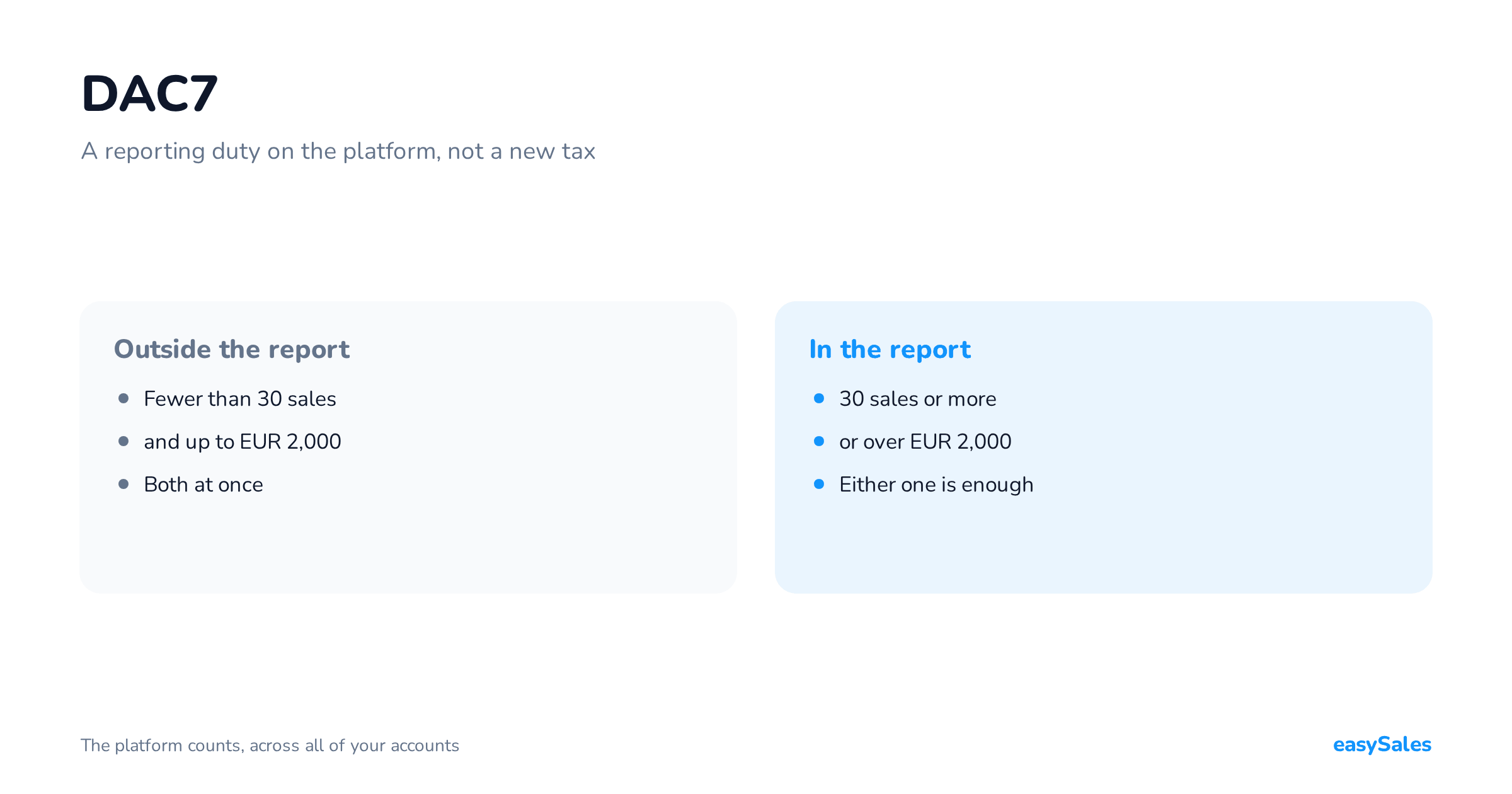
What stays outside the report is the so-called excluded seller. For the sale of goods, the directive defines one through two conditions that have to hold together.

Why both conditions work together
Annex V of the directive speaks of a seller for whom the operator facilitated fewer than 30 activities in the sale-of-goods type and whose total consideration did not exceed EUR 2,000 in the reporting period.
Since the exclusion needs both conditions, crossing either one is enough for the seller to stop being excluded. That is why platforms ask for data once a single limit is passed.
On podatki.gov.pl the operator section speaks of meeting both conditions "together", while the seller section summarises it as "one of the conditions". The safer reading is the one that matches the directive and what platforms actually do.
How EUR 2,000 is converted
The amount is converted into zloty at the central bank's average rate announced for the first working day of the reporting period. A mid-year rate is irrelevant here.
OLX states the arithmetic outright: for 2024 it was the 2 January rate, and the equivalent of EUR 2,000 came to PLN 8,686.80.
What counts as a transaction
Only completed transactions count towards the threshold. Publishing thirty listings that nobody bought creates no reporting duty on the platform's side.
Where the platform gets your data and what it asks for
The platform already holds part of the data from account registration. What it usually lacks is what selling never required: a tax identification number, a date of birth and a VAT number.
When the request arrives
The act fixes the latest possible moment. For a seller of goods it is the day the thresholds are crossed; for the other activities it is the day the seller became an active seller.
What exactly they ask for
On a private account, usually a PESEL or NIP, a date of birth and confirmation of the address. If you hold none of those numbers, place and date of birth stand in for the TIN.
On a business account most of the data is pulled from registration details. What remains is the VAT number, any tax numbers from other states, and the permanent establishment declaration.
Verification, not just collection
Due diligence covers checking the data, establishing tax residence, and separating reportable sellers from excluded ones. The operator has until 31 December of the reporting period to finish it.
The platform keeps the collected information and evidence for five years from the end of the year the filing deadline fell in. Your own figures should reach back at least as far.
What happens if you do not supply the data
The act describes a closed path here and leaves the platform no discretion. It also follows from it that silence costs money rather than saving any.

Twenty days, two repeats, sixty days
If the platform receives nothing within 20 days of its request, it has to ask again, and where there is still no answer, once more without delay.
Where the data has not arrived within 60 days of the first request despite two repeats, the operator must withhold the payout of consideration until it does.
The order of the blocks
Blocking the ability to sell is neither the first step nor the platform's choice. It comes in only where withholding the payout is not possible.
Both blocks are temporary. They come off once the data is supplied, and both Allegro and Vinted confirm that in their seller help pages.
DAC7 and your own accounting
The report is information about numbers, not a tax determination. The Ministry of Finance notes that crossing the thresholds and being reported does not automatically mean tax is due.
What the report changes in practice
It changes the fact that the authority now holds a statement of your platform sales, quarter by quarter, with commissions and an account number. The same sales should be reconstructable from your own records.
So the only sensible work on the seller's side concerns data consistency, not the report itself. We covered keeping those figures in one place in the piece on order handling software.
There is nothing for a seller to work around
The counting happens on the platform's side, from its own transaction records. The seller files nothing and declares nothing, so there is nothing here to leave out.
Splitting sales across several accounts changes nothing either. Allegro counts transactions and value across all your accounts, and OLX joins business accounts registered on the same tax number.
Whether and how a particular sale is taxed is a separate question, and it sits outside DAC7. That one goes to an accounting office, not to a form inside a platform's panel.
DAC7 on Allegro, OLX and other platforms
The duty is the same, but each platform defines a transaction differently and limits the range of sales it reports differently. You only see that difference in a given service's own help pages.

Allegro
Allegro counts transactions and sales value across all your accounts, jointly for Allegro and Allegro Lokalnie. A transaction is one order in one listing, however many units it contained.
Two orders from the same listing at different times are two transactions. The data reported and the quarterly sales summary sit in the DAC7 Data tab.
OLX
OLX reports only sales carried out with OLX Shipment. Listings without that service, along with the Accommodation, Services and Property categories, stay outside the directive.
The form appears in the Profile tab and a link to it also arrives by email. With several business accounts on the same tax number you fill it in once, on the main account.
Other platforms
The pattern repeats everywhere: a pre-filled form in the account, two email reminders, then the payout block. Vinted adds a page showing the account's DAC7 status.
Where to get your own figures to compare
A copy of the report is only useful if you have something to set it against. Every line in the report has a counterpart in your own sales data.
| Report line | What the platform shows | What you check it against |
|---|---|---|
| Number of activities | Transactions completed in that quarter | Order count for the same quarter |
| Total consideration | Amount paid or credited | Sum of payments received for orders |
| Fees and commissions | Charges withheld by the platform | Settlements with the platform |
| Account identifier | Account number from sales settings | The account the payouts reached |
| Identity data | Tax number from the DAC7 form | Company registration details |
One place instead of four exports
Selling on several platforms means comparing the figures separately for each, because each reports on its own behalf. A shared order record shortens that work to one filter by date.
In easySales, orders from every connected channel land in one list with a date, an amount and a channel, so the transaction count and sales total for a quarter are readable without exports.
If you are only now changing systems, make sure the history travels with you — moving order history decides whether you can be compared against a report for earlier years.
What to prepare so the figures agree
It all comes down to a handful of fields the platform has to hold correctly, and one statement you have to be able to reproduce.
Five things to check when a platform asks for DAC7 data
- A tax number matching your registration details, with no typos and no retired numbers.
- The VAT number if you hold one — an empty field is not the same as having none.
- The primary address as registered, not a warehouse or a pickup point.
- A current payout account, because its identifier goes into the report.
- Your own order figures for every quarter, ready to compare against the copy of the report.
The deadlines, thresholds and data scope described above come from the DPI section on podatki.gov.pl and from the text of the directive. The tax consequences of your own sales are for an accounting office to assess — send questions about your situation there.